How to Notice Which Sounds Help You Concentrate
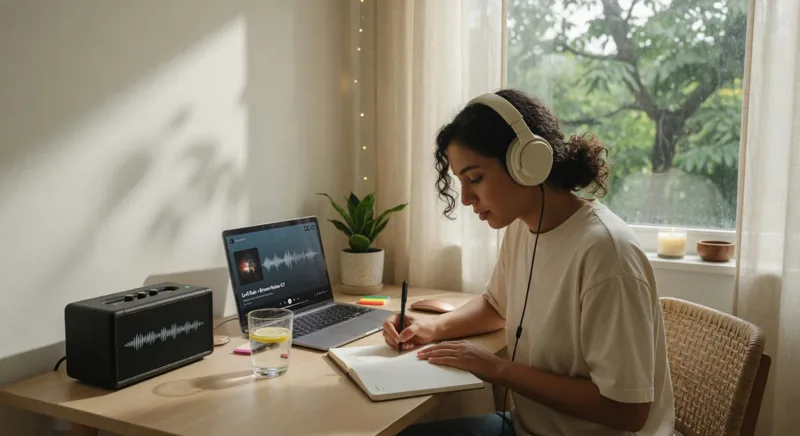
Learning how to notice which sounds help you concentrate can make studying, reading, writing, and office work feel easier. The best focus sound is personal: it may be silence, instrumental music, nature sounds, white noise, or a steady fan. The key is to test how each option affects your attention—not simply how pleasant it feels.
Why Some Sounds Improve Focus
Sound can influence concentration in several ways. A steady background sound may cover sudden conversations, traffic, or household noise. Music can also improve mood and motivation, while predictable audio gives your brain fewer unexpected changes to process.
However, sound can become a distraction when it competes with the task. Music with lyrics is especially likely to interfere with reading, verbal memory, and other language-based activities.[3] Even music that feels enjoyable may quietly reduce comprehension.
Research on white and pink noise suggests that the effect varies between people. Some studies report small attention benefits for people with ADHD symptoms, while the same sounds may slightly impair performance in people without ADHD.[2][4] This is why personal testing is more useful than assuming one “best sound” works for everyone.
Start by Identifying Your Concentration Pattern
Before choosing a focus soundtrack, notice what usually breaks your attention. Ask yourself:
- Do conversations distract you more than music?
- Are sudden noises worse than continuous background sound?
- Do you lose focus when music changes tempo or volume?
- Does silence make you restless or overly aware of small sounds?
- Does your task involve reading, writing, calculations, or creative thinking?
Your answers provide useful clues. If unpredictable sounds are the problem, consistent ambient noise may help. If your work involves language, silence or instrumental music may be a better starting point.
Sounds Worth Testing for Better Concentration
Silence
Silence is often the best choice for reading comprehension, memorization, proofreading, and complex writing. It removes competing information, although complete silence can feel uncomfortable if you are used to a busy environment.
Instrumental music
Instrumental music, classical music, lo-fi beats, and ambient music can provide structure without adding understandable words. Choose tracks with a steady volume and moderate tempo. Avoid songs that make you want to sing along or check the artist.
White, pink, and brown noise
White noise contains a broad mix of frequencies and can mask nearby conversations. Pink noise is often perceived as softer, while brown noise emphasizes lower frequencies and may sound deeper.
Evidence is mixed, so treat these options as experiments rather than guaranteed concentration tools. One study found that approximately 45 decibels of white noise improved sustained attention and creativity without increasing stress, while louder white noise produced different results.[1] Keep the volume comfortable, especially when using headphones.
Nature sounds
Rain, ocean waves, flowing water, and forest ambience may help create a calm workspace. These sounds are most useful when they remain predictable. Avoid tracks containing sudden thunder, bird calls, or dramatic changes if interruptions tend to pull you away from work.
Everyday steady sounds
A fan, air purifier, quiet café ambience, or gentle ventilation system can work as natural background noise. These options may be easier to tolerate than artificial audio because they do not demand active listening.
Use a Simple Focus Sound Experiment
Instead of changing sounds every few minutes, test one option properly. A short concentration experiment can reveal what actually works.
- Choose one moderately difficult task, such as reading a chapter or completing practice questions.
- Work for 20 to 30 minutes with no background sound.
- Record your focus, stress, task completion, and number of interruptions.
- Repeat the task on another day with instrumental music, nature sounds, or steady noise.
- Compare your results rather than relying only on how relaxed you felt.
Use a simple rating from one to five for concentration, mental fatigue, distraction, and productivity. A sound that feels pleasant but leaves you remembering less is probably not the right choice for that task.
Match the Sound to the Type of Work
| Task | Sounds to Try | Sounds to Avoid |
|---|---|---|
| Reading and writing | Silence, soft instrumental music, gentle rain | Lyrics, podcasts, talk radio |
| Routine computer work | Lo-fi beats, café ambience, fan noise | Highly energetic or familiar songs |
| Creative work | Ambient music, nature sounds, quiet instrumental tracks | Sudden volume changes and distracting vocals |
| Memorization | Silence or very subtle steady noise | Music with lyrics and spoken audio |
Notice Warning Signs That a Sound Is Hurting Focus
A background sound may be working against you if you repeatedly skip tracks, monitor the beat, replay favorite songs, or notice yourself following lyrics. Irritability, headaches, ear fatigue, and rising stress are also signs to lower the volume or stop listening.
Do not assume louder is better. Increased volume can make background noise more noticeable and may contribute to listening fatigue. Comfortable, low-level sound is usually a safer starting point than intense audio.
Build a Personal Concentration Sound Profile
Keep a short list of sounds that work for different situations. For example, silence may be best for studying, instrumental music for routine tasks, and brown noise for blocking nearby conversations. Your ideal choice may change depending on sleep, stress, workload, and the environment around you.
The goal is not to find one perfect focus soundtrack. It is to notice patterns: which sounds reduce interruptions, support steady attention, and leave you feeling mentally clear after the session.
Conclusion
To notice which sounds help you concentrate, compare silence, instrumental music, nature sounds, and steady background noise during similar tasks. Track your actual performance, not just your mood. With a few careful experiments, you can create a flexible concentration routine that suits your work style, environment, and attention needs.