The Case for Making Something You Never Plan to Share
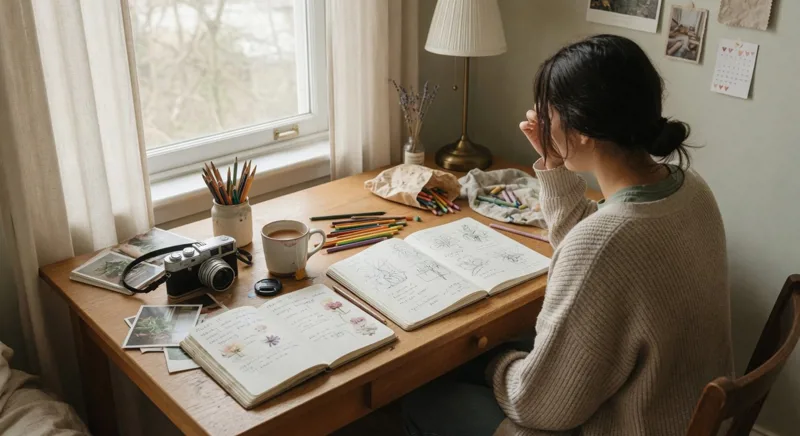
In a world built around likes, comments, and personal branding, making something no one else will see can feel almost rebellious. Yet private creative work may be some of the most valuable work you ever do. It gives you room to experiment, think honestly, and enjoy the process without asking whether the result is marketable.
Why Private Creativity Matters
When you create for an audience, your attention naturally shifts toward judgment. Will people understand it? Is it good enough? Could it become a side hustle? Those questions can be useful at the right time, but they can also interrupt curiosity.
The case for making something you never plan to share begins with removing that pressure. A private project does not need to be polished, useful, profitable, or impressive. It only needs to be meaningful to you.
That freedom changes the creative process. You can write a messy short story, sketch an awkward portrait, record an unfinished song, design an imaginary room, or keep a journal that no one else will ever read. The goal is not public approval. The goal is honest participation.
The Benefits of Making Something Just for Yourself
1. You can experiment without fear
Public work often encourages safe choices. A private project gives you permission to try unusual ideas, make mistakes, and abandon them without explanation.
- Test a new writing style.
- Learn a musical instrument through imperfect recordings.
- Explore painting techniques without worrying about quality.
- Build a personal website or app as a learning project.
- Develop characters, recipes, photographs, or designs that may never leave your files.
Experimentation is easier when failure has no audience. Over time, those low-stakes attempts build creative confidence and practical skill.
2. You reconnect with intrinsic motivation
Intrinsic motivation is the desire to do something because the activity itself feels rewarding. It is different from creating for money, recognition, followers, grades, or career advancement.
Private creative practice helps you remember what originally attracted you to an activity. Perhaps you started drawing because you liked observing small details. Maybe you wrote because arranging words helped you understand your thoughts. When external rewards disappear, the underlying reason becomes clearer.
This matters because creativity can become exhausting when every project is treated like content, a product, or a personal branding opportunity. A private project restores a sense of play.
3. You make space for honest self-expression
Some thoughts are difficult to say aloud. Writing, collage, photography, music, or movement can provide another way to process them. A private journal, for example, allows you to describe emotions without editing yourself for another person’s comfort.
Research on expressive writing suggests that putting difficult experiences into words may support emotional processing, although journaling is not a replacement for professional mental health care.[1][2] The value often comes from creating distance: once a feeling is placed on paper, it can become something you observe rather than something that completely controls your attention.
Private Projects Can Improve Public Work
Making something only for yourself does not mean the work has no wider value. Private practice often strengthens the skills that later appear in public projects.
A photographer may develop a sharper eye by taking daily photographs that remain on a hard drive. A writer may discover a stronger voice through pages that never become an article. A designer may solve difficult problems while creating imaginary projects with no client brief.
The absence of an audience encourages deeper learning. Instead of rushing toward a finished result, you can spend time noticing what works, what feels natural, and what still needs practice.
How to Start a No-Share Creative Project
- Choose an activity that interests you. Try creative writing, drawing, cooking, gardening, coding, photography, music, or crafts.
- Remove the performance goal. Decide in advance that the project does not need to be published, sold, entered into a competition, or shown to friends.
- Set a small container. Work for 15 minutes, fill one page, make one sketch, or complete one tiny experiment.
- Use a private space. A notebook, password-protected document, personal folder, or quiet corner can reinforce the feeling of safety.
- Record observations instead of judging results. Ask what surprised you, what felt enjoyable, and what you would like to try next.
You can also create a “permission project” with deliberately low standards. Make ten bad drawings. Write a deliberately dramatic poem. Build a strange playlist. Photograph ordinary objects from unusual angles. The point is to loosen the habit of self-censorship.
When Sharing Is Not the Goal
Modern creative advice often focuses on building an audience, monetizing a skill, or turning a hobby into a business. Those paths can be worthwhile, but they are not requirements for a meaningful creative life.
Not everything has to become a portfolio piece. Not every hobby needs a return on investment. Some work can remain a private record of your attention, growth, memories, and imagination.
Creative activities are associated with several wellbeing pathways, including positive mood, stress relief, autonomy, curiosity, and immersion.[3][4] Those benefits do not depend entirely on public recognition. In many cases, the freedom to choose what to make and how to make it is part of the benefit.
The Quiet Value of Unseen Work
Making something you never plan to share may feel unproductive because it produces no obvious external result. But productivity is not the only measure of value. Private creative work can help you become more observant, patient, expressive, and comfortable with uncertainty.
It can also give you a place where your identity is not being measured. You are not a creator trying to perform creativity. You are simply a person making something because the act of making matters.
That is the central case for private creation: it protects the part of creativity that exists before approval. Make something unfinished, unnecessary, and entirely your own. You may never show it to anyone—and it may still change the way you see yourself and the world around you.